Laura Zera

Stories to Connect Cultures

  • Writing
    • Blog
    • Books
    • Portfolio
  • Speaking
  • About
    • Bios
    • Contact
    • Privacy Policy

A Day Spent in Tela, Honduras

By Laura Zera 8 Comments

It’s always amazing to me how much brighter my outlook on life is on the day after a transit day. After a long day on the road (and usually arriving at my destination at night), hotel rooms always seem to look a little grungy, people a little shifty, streets somewhat inhospitable. It was like that when I arrived in Tela. When I got up on February 5th, though, with the sunshine coming through my window my hotel room looked pretty decent. Outside, children played. The streets were alive with the bustle and noise of daily commerce. It was a whole new place.

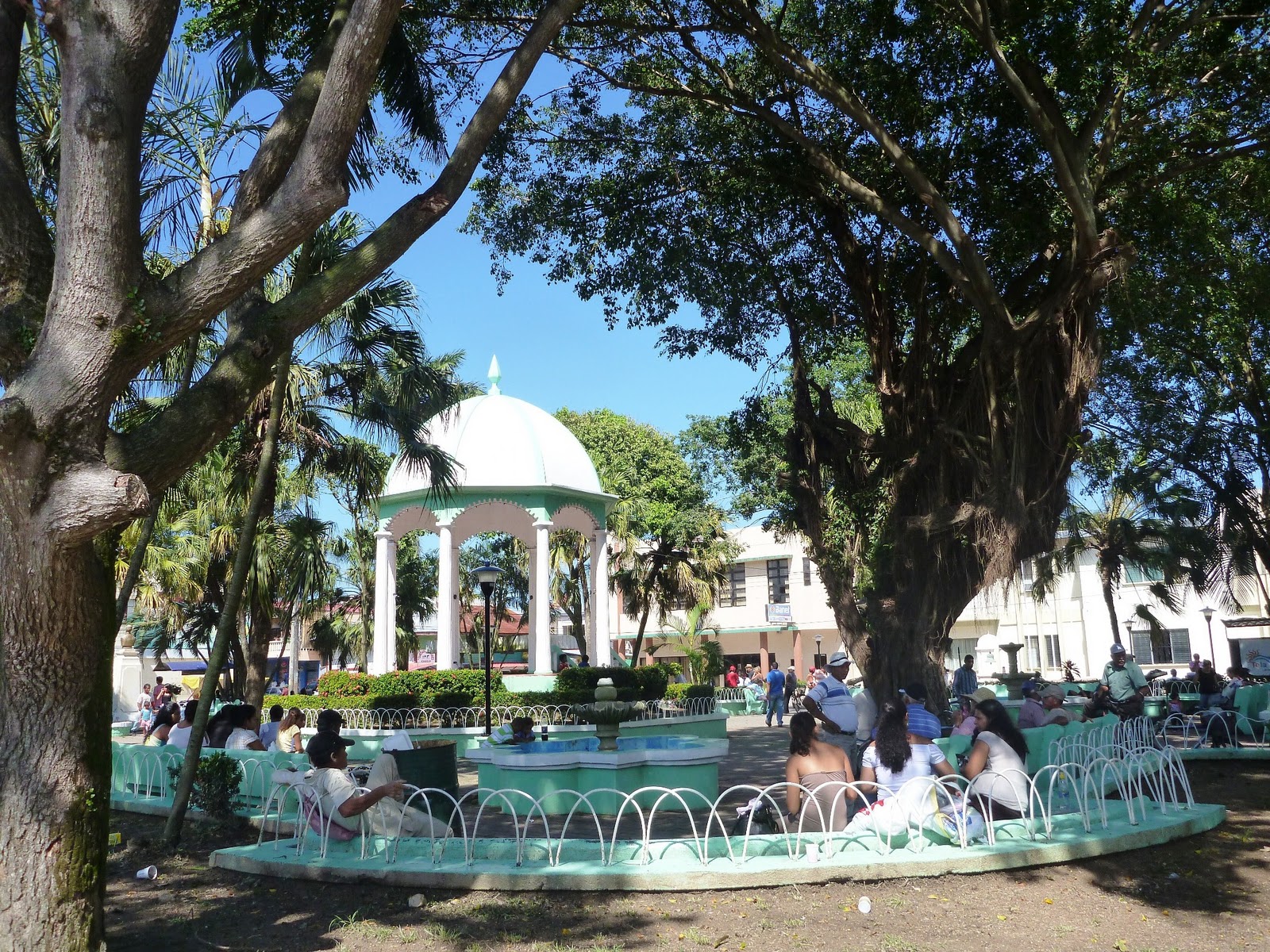
Originally I had thought that I might take a boat tour over to the nearby Parque Nacional Jeannette Kawas or maybe rent a bike and ride to a nearby botanical garden, but when I woke up, I didn’t feel like going anywhere quickly. Instead, I used the day to stroll around Tela, drink a lot of coffee, do some people watching, and take in sunset on the beach.

I’d heard mixed reviews about Tela from other travelers, but I quite enjoyed it. I only saw about six other tourists throughout the day, and the rest of the people hanging out on the boardwalk or having a picnic on the beach were Honduran. Like Dangriga in Belize, Tela felt very authentic to me. The wares for sale along the main street weren’t oriented to tourists; there were Dora the Explorer backpacks, a lot of kitchen items, and a lotta lotta colorful plastic – China has been here, too!

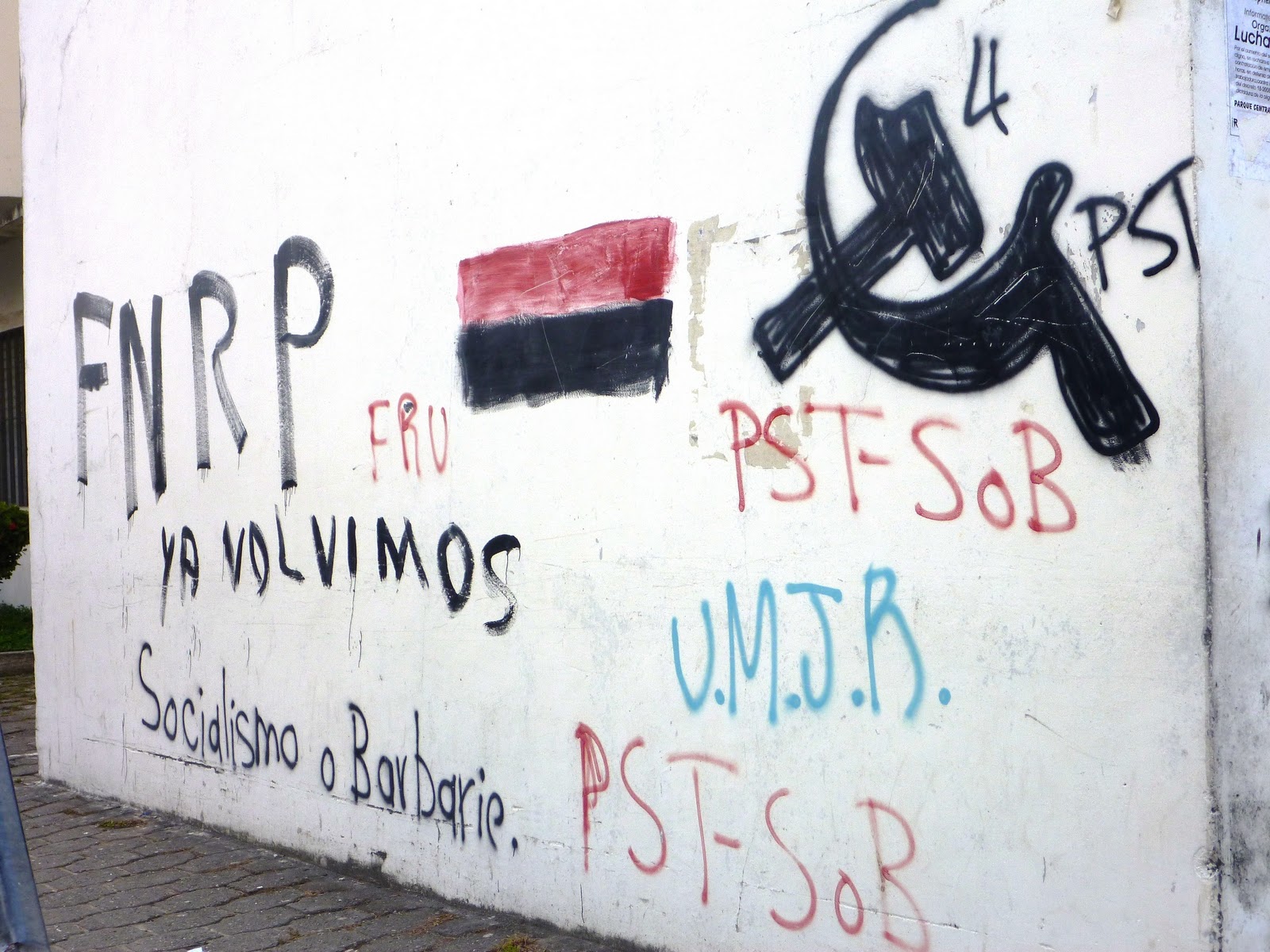
Everywhere I went, I found political graffiti spray painted on building exteriors. I’m going to have to do some searching on the interwebs to see what that’s all about when I have some time.
There were several banks around the Parque Central hub. The one in which I changed some money also doubled as a furniture store. There were several sofa and loveseat sets, some major appliances, apparently a BIG sale going on, and then a couple of teller windows off to one side.
I had an early dinner that night. I’d found the restaurant where I wanted to dine — it had conch on the menu – while walking around in the afternoon and then mistakenly asked them “At what hour it’s open?” instead of “Until what hour it’s open?” When the waitress said six, I thought it very odd, but didn’t question it. I came back for dinner at 5:45 p.m. and then realized my Spanish stupidity as more and more people arrived the later it got. Doh!

The beach didn’t have stunning blue Caribbean water, but I could see it just off in the distance! What a tease. Closer to shore, it was pretty brown. I noted that there were lots of garbage bins tied to palm trees on the beach – always a good sign. More importantly, people seemed to be using them!

There was a good smattering of restaurants and bars along the boardwalk, although the only one that I found that had Wi-Fi was César Mariscos. Of course, it was also the most expensive restaurant. I self-sacrificed by buying a strawberry daiquiri while I was having a Skype chat with my hubby.

The Sinai hotel had cable TV (still no hot showers, but there was a TV).  At home I average about three hours of TV per week, most of it while on the treadmill at the gym, but with the dark streets of Tela being so uninviting, I zombied out on three consecutive episodes of House. Those writers really need to shake up the formula a bit – it is so predictable! What’s not predictable is my schedule. I haven’t decided where I’m going tomorrow, and I love that about this trip.

From Belize to Honduras by Water Taxi

By Laura Zera Leave a Comment

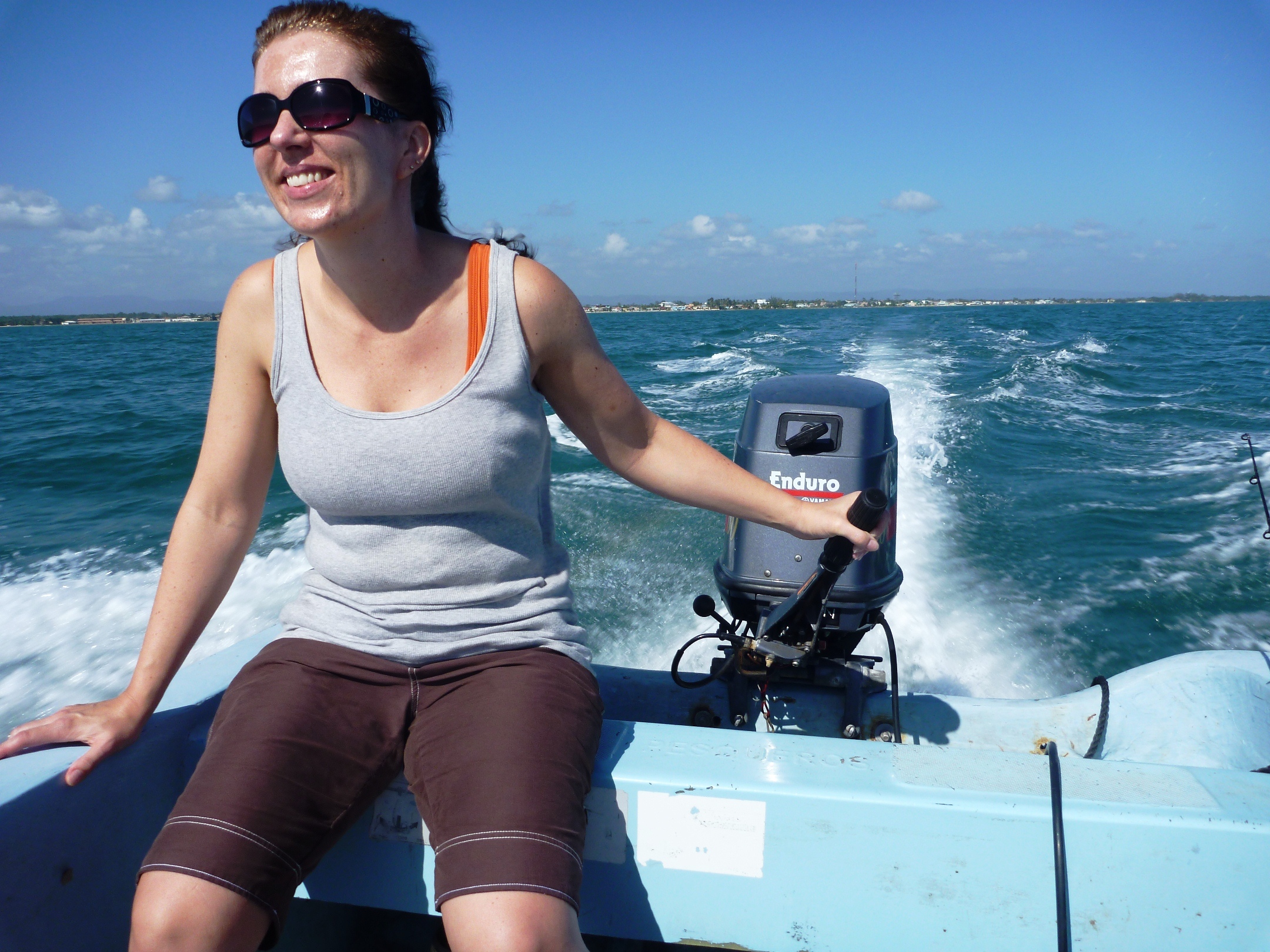
And a big ol’ taxi it was: there must have been about 20 people onboard! But again, I sat down and found myself facing the ever-present sign, “In God We Trust.” I wanted to say, “Yo Captain, I’m trusting in you, okay, to get this dang boat to the other shore. Show me what you’ve got.”

Argh, it was a long travel day on Feb.4th.  This blog post is full of practical details for other travelers doing the same route, though.
The available verbal, written and online information on the departure time of the Nesymein Neydy varied between 9, 9:30 and 10 a.m. I showed up at 8:30 to get a ticket and hand in my passport for immigration. The boat, however, didn’t leave until 11:30. Apparently, that’s a normal delay.
One passenger attempted to take an eight-week old pit bull puppy with him. “You allowed to do that?” I asked, as his puppy’s head popped out between the top flaps of the cardboard box in which he was being transported. “I think so,” was the answer I got. The pit bull never made it on to the boat. I’m still not sure if that was a good thing or not: stay with clueless owner that keeps you in a box, or stay with unknown person for unknown length of time until clueless owner can retrieve you. If I was the puppy, I would have made a break for it.  
We pulled up to Puerto Cortes, Honduras at around 2:45 that afternoon, and a good chunk of the passengers went over the bridge and around the corner to the bus stop. The downer about wanting to travel the northern coastline of Honduras is that you can’t! There is no road. (Same with trying to get from San Pedro Sula straight to the Guatemala border: must go through Puerto Cortes).
And hence the bus portion of the day began. I got a collectivo to San Pedro Sula (SPS), but despite many attempts at asking, it was still unclear to me from which terminal the bus to Tela left – I think there are a couple. Finally, the man sitting next to me jumped up and said, “Here!” He escorted me off the bus and two blocks down the street to the correct bus station. I really don’t know if my stop was his stop, but he sure helped when I needed it!
Unfortunately, at that time of day (about 5 p.m.), there were no more direct buses to Tela, so I had to get one bus to El Progreso, and then another to Tela. Bear in mind that these are the repurposed Blue Bird school buses, packed to the gills, and I had to stand for a long while on the last bus. I also hadn’t eaten since breakfast, so was getting a little bit weary.

Following about 100 paces behind me and my gentleman escort (who eventually went on his way) was another Canadian, a fellow named Curtis that had started out from Dangriga that day as well. Once he caught up to me, we rode the rest of the way to Tela together, arriving at about 7:30 p.m.

Our first two attempts to find a hotel room were a fail. It was Friday night, and Tela is the place where Hondurans from SPS get away for their beach weekends. On our third attempt (at the Hotel Sinai, based on our taxi driver’s suggestion), we got lucky. My room was cramped, mostly clean, and $15 USD. The rooms without private bathrooms were $12.
Curtis decided to shower and hit the sack, so I went out for a little wander to find some food. Tela has a reputation for being a little dodgy at night, so I only took a couple of dollars in my pocket and my room key, and off I went. The streets were so empty that it was a bit unnerving, and almost no businesses were open. I felt better when I reached the Central Square area and saw a group of people practicing Honduran folk dancing in the lobby of the City Hall building.
After going a couple of blocks further I found three or four basic restaurants. I bought a deep-fried thingy (have yet to find a name or description for it online) from the front counter of one and ate it as I walked back to watch more folk dancing. I was thus far underwhelmed with Tela, though, and hoped that it would look a lot more inviting during the day.

Tobacco Caye, Belize

By Laura Zera 1 Comment

Still in Dangriga, down to the Riverside Café I went, in search of breakfast, Wi-Fi, and Captain Doggy. I found him in the Café’s kitchen, making his own breakfast. We ate, waited for a bit to see if any other people would turn up for a lift to the Caye, then left mid-morning.

As soon as we cleared the shallow waters around the mouth of the river and were into the sea, Doggy asked me if I wanted to drive the boat. “Here, you go like dis, and then to speed up you go like dat, and to turn it’s like dis and like dat.” I took over control of the outboard motor and did a fairly fine job for the next twenty minutes or so until my hand started to cramp. Dats when the Captain took the boat back.

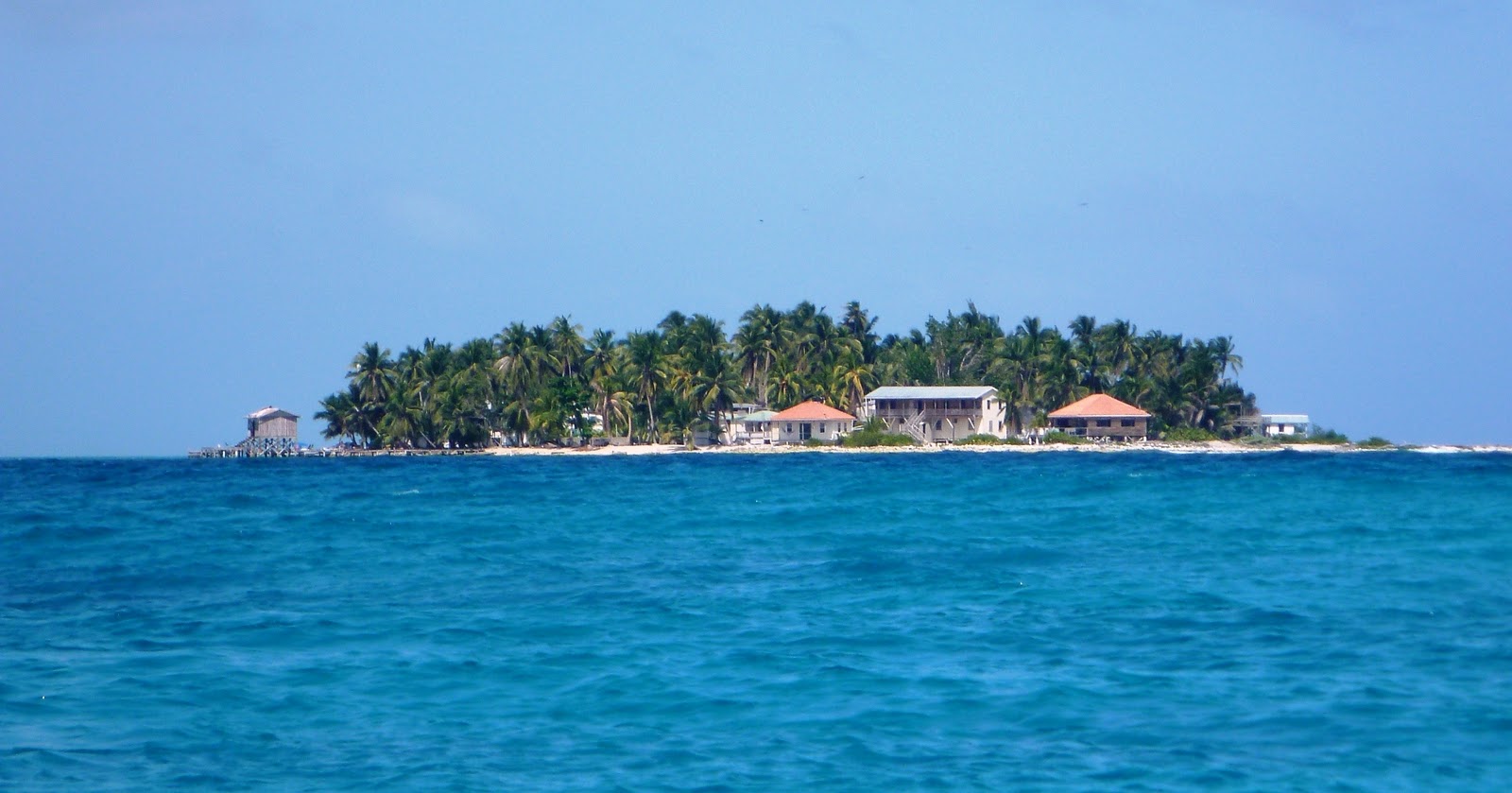
The closer we got to Tobacco Caye, the bluer the water. I got the same perma-grin on my face that I had both times that Francis and I went to Fiji; to be surrounded by blue sky and turquoise blue water makes me feel absolutely giddy. Doggy zigged and zagged through the mangroves very Miami Vice-style, which made me giggle even more. When we finally pulled up to Tobacco Caye, it was exactly what I’d hoped for: a round lump of sand and palm trees totaling 80,000 square feet. It didn’t matter where I was standing, I could see water on both sides.

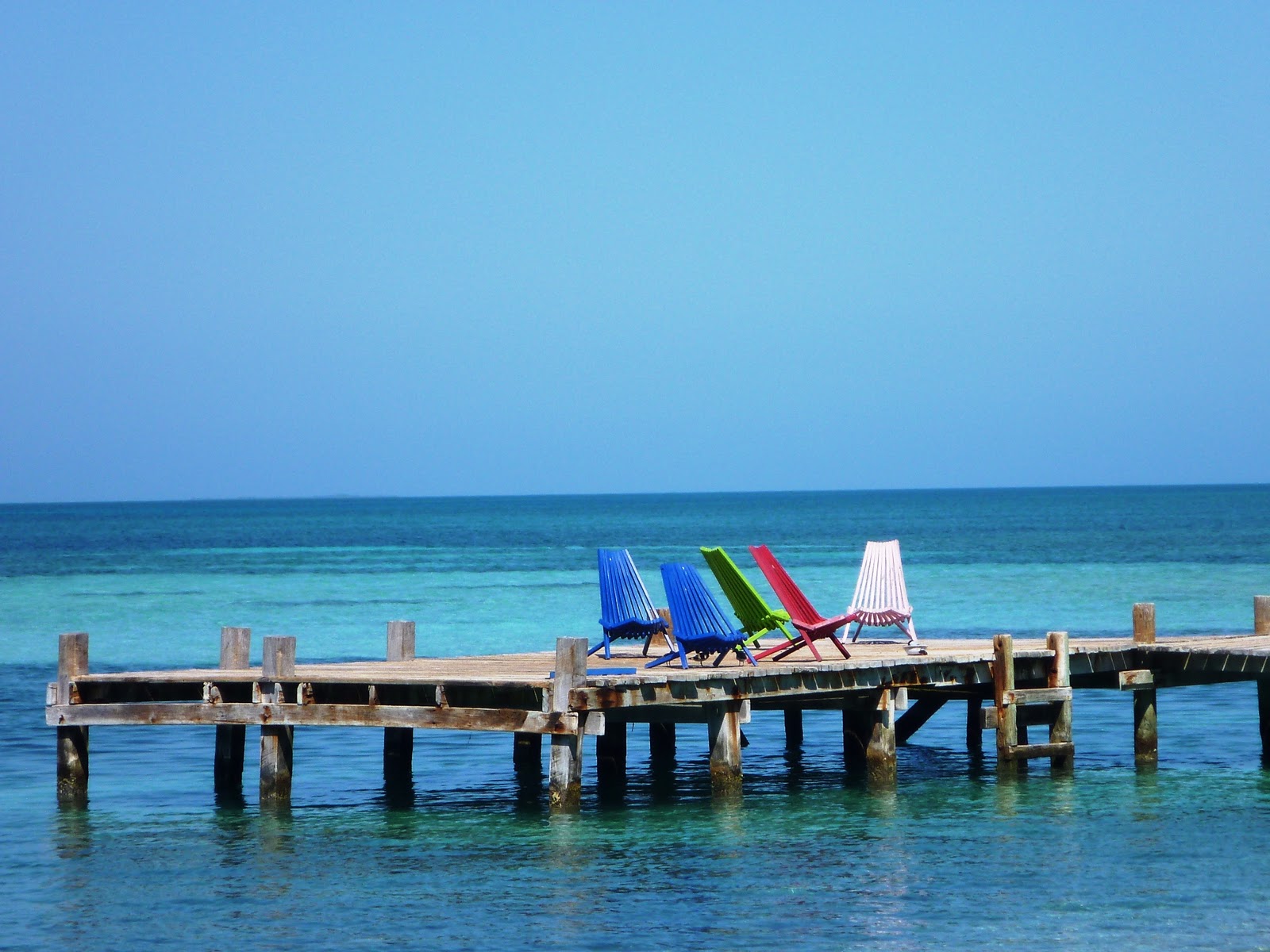
I stayed at Gaviota, and scored what I considered the best cabana of all. It was built on stilts over the water and had a little porch with a couple of Adirondack chairs, and an unobstructed view. I had to use the shared bathroom, but that was okay, because for $25 USD a night, the deal included all of my meals. There were hammocks, lots of birds and palm trees, and a couple of really nice folks running the place. Happy, happy, happy.

Doggy Dog gave me two options: come out with him and another family of six to do some snorkeling off the boat that afternoon for $12.50 USD, or wait until the next day and he’d come back to the island at around 2 pm and take me out alone for free. I said, “Let’s do both!” As it turned out, Doggy ended up taking us all out again the next day for free. This was perfectly fine with me because the family (American-Belizean husband Miles and Belizean wife Susie) had two completely adorable kids that even warmed the cockles of my black and childless heart. The kids’ granddad and his buddy were down visiting from California, and they added some interesting stories to the whole mix.

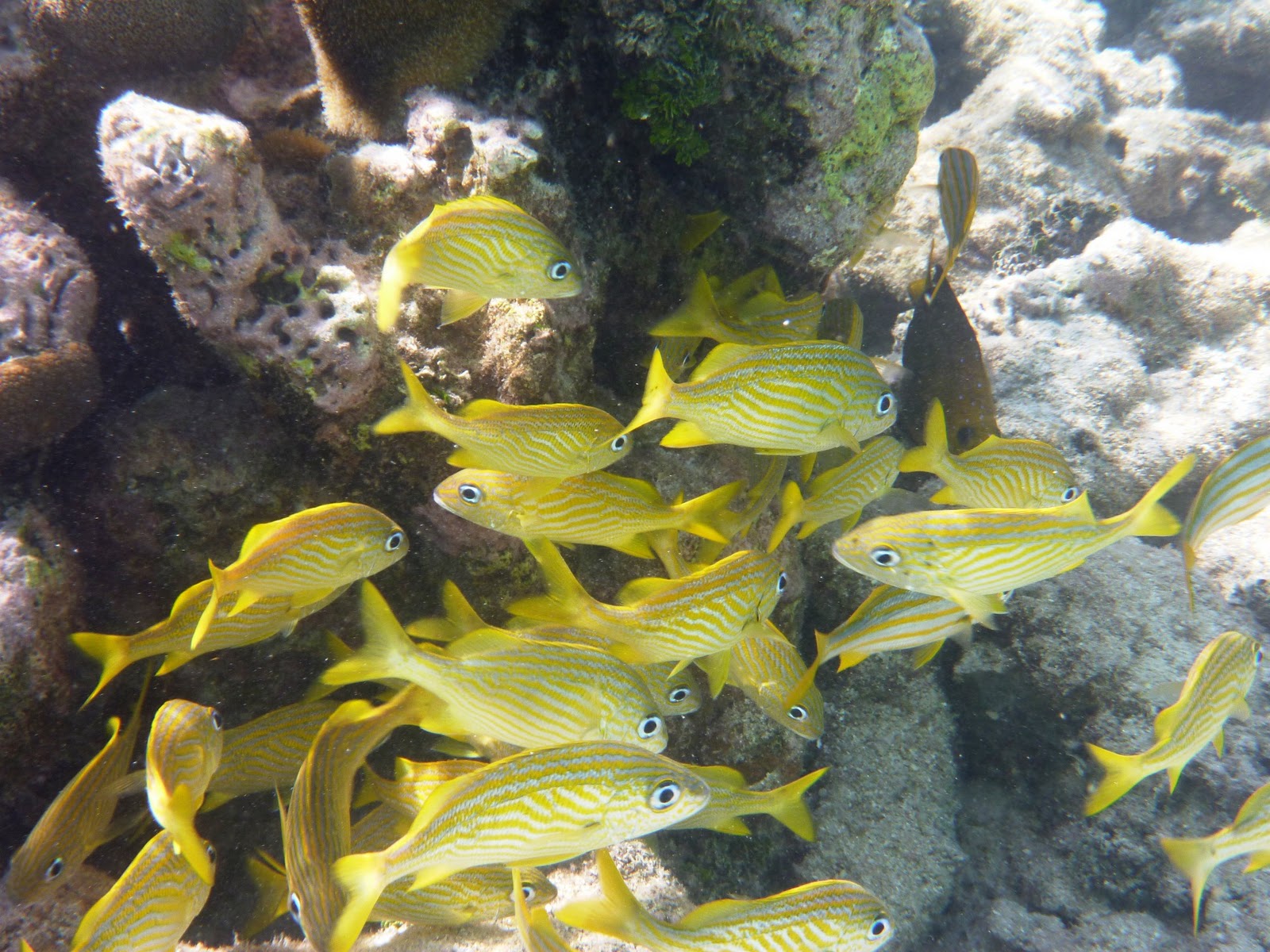
The snorkeling was great: schools of gigantic fish, lots of colorful coral, and calm and clear water.

Susie did a fine job at her first attempt at fishing, and reeled in three or four barracudas and a snapper or two on the first afternoon, all of which she cooked on a borrowed grill later that night.

When I wasn’t in the water, I spent the rest of my time either in a hammock, or on my little deck, listening to the water and to my favorite new bird, the boat-tailed grackle, master of mimicry. Meals were served at picnic tables, so all the guests (just me and the other family) ate together. I slept very soundly in my little cabana, with the breeze coming through my open windows and the Caribbean sounding just like the ocean setting on my Homedics Sound Spa machine at home.

If it weren’t for the fact that the boat from Dangriga to Puerto Cortes, Honduras only runs once a week, on Fridays, I would have stayed longer. By 4 p.m., we’d shoved off for our run back over to the mainland.

Dangriga, Belize

By Laura Zera 2 Comments

A lot of people come to San Ignacio, Belize to go on outdoor excursions, e.g. cave trips, rafting, etc.  I used it only as a stopover on my way to Dangriga, on the coast. I might have stayed longer had I jived with the vibe of the place, but I didn’t, so I kept on going.

To get to Dangriga, I had to first get a bus to Belmopan, Belize’s capital city. That was a pretty short trip, maybe an hour or so. I can’t remember exactly, because I was fixated on the John Oates lookalike (circa 1984) that was on the bus. We must have had some kind of karmic attraction because we cracked heads as we were walking into the terminal in Belmopan. After that, I could suddenly remember all the words to all the Hall and Oates songs that ever got air play. It was a dream come true.
I waited for my next bus for about an hour, and it was prime people-watching time. A stout little boy of about nine or ten was circling the terminal, selecting victims to hit up for a dollar. He passed by three times before he finally asked me. I looked at him and said, “Why are you going around asking everyone for money? You don’t need the cookies anyway. They’re not good for you.” He paused for a moment, and then sidled away and on to the next person. There’s a sucker born every minute, as they say, and over the next little while I saw him stop by the concession counter three times to purchase mini Snickers bars.
Meanwhile, a Mennonite family had come in to the terminal. Talk about sticking out! Father in his round-brimmed straw hat, mother in her kerchief, and three blond tow-headed boys with their matching green shirts buttoned up to the top underneath their navy coveralls. I later learned that there’s a Mennonite community settled along the Hummingbird Highway (and probably in other places, too). They farm, and run a dairy, a bakery, and other small businesses.
My admiration for photojournalists has been steadily growing on this trip. There have been so many times when I missed a great shot – either didn’t have my camera out, or took a picture but failed to capture the moment — or haven’t wanted to try to sneak a picture out of fear of upsetting the subject or showing disrespect. But man, so many of life’s little moments are picture-worthy.
Dangriga was hot, and I had a hard time finding a room in my desired price range. Everything was either too rustic (I’m past the dorm stage of my life) or way overpriced. I stumped around to five different places before collapsing in a puddle of sweat at Pal’s Guesthouse. My $32-a-night room wasn’t all that great inside, but it was right on the beach and had a lovely little veranda from which I could take in the sunset.
The town itself was what I would call ‘authentic.’ There wasn’t much in place just for the sake of tourism, and the main street was made up mainly of grocery stores, medical clinics, hardware stores, banks, and a few basic restaurants. The grocery stores were all run by Chinese immigrants. I always find it interesting how pockets of immigrants settle in random places. I guess there are business opportunities everywhere.
When I asked around for wireless, I was told that the only option was an internet café (which I later learned was false – Riverside Café has it!), so I stopped in there at about 5 p.m., and was amazed at the length of the queue. As it turns out, it’s the place where the kids come to do their school assignments. The school teachers give the café manager a list of the current assignments, so when the kids come in, they just say, “Ms. Smith’s class, the assignment on the history of Belize,” or whatever. (Not that I could understand the Creole/Garifuna-speaking kids!). The café manager finds a file and prints it out for them. They later get it signed off to show that they were there to do the work. I also passed by some kids doing their homework at about 6:30 p.m., sitting out on the front lawn under a street lamp. It reminded me of the lyrics from the Dave Matthews Band song Funny the Way It Is – “Funny the way it is, if you think about it. One kid walks 10 miles to school, another’s dropping out.”
Walking in from the bus station when I first got to Dangriga, a guy in a white pick-up truck with some pretty fancy braids in his hair had pulled over and called out, “Hey, are you going to Tobacco Caye?” “Probably,” I said. He introduced himself as Captain Doggy, boat operator, and gave me the rundown — $35 USD round-trip for the trip out, and a place on the Caye called Gavriota where $25 would get me a cabana on stilts over the water (shared bathroom), and included all my meals. The two backpackers that Doggy was taking to the bus terminal nodded enthusiastically as espoused the awesomeness of it all, and so I said, “sign me up!”
I was to meet him at the Riverside Café later that night to finalize it, but it turned out that I didn’t need to as he passed me on the street again a few hours later and we figured out the rest of the details.  The Lonely Planet described Tobacco Caye as a Gilligan’s Island, and Lord knows I sure do loves me a good hammock.

Tikal at Dawn

By Laura Zera Leave a Comment

I’m actually in Tela, Honduras today, but here’s my post from my second day at Tikal.
———–
The gates at Tikal officially open at 6 a.m., however if you book a tour with a guide, or pay 50 quetzals to a guard, you can get through the gates early enough (e.g. 4:45 or 5 a.m.) to do the pitch-black walk to Temple IV, the sunrise temple. On the day that I did this excursion, Jan.31st, there was a heavy cover of jungle mist. I walked in with my guide, Jairo, and two other backpackers, the lovely Heidi from England and the equally lovely Adrianna from Brazil.
Shortly after we started in, Jairo stopped, listened, and moved us to the side. Fo’ shizzle, those dang monkeys were trying to pee on our heads. Good thing that he was alert to it, as I later met an Israeli couple who had thought maybe it was raining a little bit in the morning… I had to break the news to them that they’d had a golden shower. It took us about 30 minutes to walk to Temple IV, I think. Sunrise was at 5:45 a.m. and we got there in plenty of time to climb the 200 steps and then sit in quiet awe at the top.
It was eerie and spooky and really, really cool. The silence was punctuated by the primal screams of the howler monkeys, and the odd bit of conversation (Adrianna remarked about the people next to us, “they must be Argentinian. They never stop talking.” It made me wonder if there are any two bordering countries that don’t think uncomplimentary thoughts about their next-door neighbor!).
Dawn came and went, but we didn’t see any sun. The jungle mist lifted enough to give us momentary glimpses of the other pyramids rising up out of the trees, and then settled back in around them. It was still a magical experience, although my photos don’t do the scene any justice (those that aren’t a foggy blur). Francis asked me if I’d brought my tripod in with me, to which I replied, “oh yeaaaaaah, triiiiipod.”
Jairo took us around to several other sites, showing us Mayan refrigerators, drawing in the dirt the way that temples were built to align with the solstice sun, and explaining which elements of the Mayan civilization downfall theory that he most supported. One part of his explanation that I found interesting was regarding deforestation. He said that the Mayans didn’t dig pit toilets; instead, they would mix their waste with limestone and rainwater to fertilize their crops. The population grew, and so they cut down more trees to plant crops. The deforestation led to a decrease in rainfall, which led to a disproportionate amount of human waste in their fertilizer. Disease spread. Wars complicated matters. By the time the Spanish arrived in the 11th century AD, there were only a few Mayan settlements scattered around Lake Peten Itza.
The next mission of the day was to get to Belize. I found a tourist bus that was heading to Flores and it dropped me at the junction for Melchor, the Guatemalan border town. Once there, I stood on the side of the road and waited for something to come by that was going in my direction. It was then that I realized just how much I love the feeling of being on the road, waiting for unknown transport to arrive at an unknown time, and having that joyful “hurray” moment when something stops for me and I hoist my bags up and jump in.
On this particular occasion, the collectivo (mini-bus) that stopped had a front seat that was empty and waiting for me – a rare occurrence. We bumped along the road to Melchor, of which some stretches were smooth and others were barely paved. At one point, I let out a yelp as a humongous and clearly hard-shelled bug flew in the window and committed suicide on my right arm before rebounding to my left shoulder and then down to the driver’s feet. At one of our stops, I marveled at how a dog checked behind the bus for traffic as he approached the road, and then looked both ways again before crossing in front of us. Smart like street dog, not like pampered pug o’ mine.
The border crossing was smooth – walk walk walk, stamp passport, pay $2.50 USD to leave country, walk walk walk, stamp passport, enter new country. I also changed a few bucks along the way and was surprised to see the Queen on Belize’s money. Girlfriend sure gets around. I knew that the Brits had been there for a spell, but hadn’t realized the long-standing significance of their occupation.
A taxi took me to Benque Viejo (it’s not far, but was too much to handle in the heat with my pack), where I got the (school) bus to San Ignacio. Belize gave me my second surprise as I looked around the bus. The diversity of people was far greater than Guatemala. There were some Garifuna, some Creole, some Latino, and some interesting and beautiful mixes of all of the above.
Once in San Ignacio, I efficiently secured a room one block from the bus stop at the Hi-Et Guesthouse (not sure if it was named after the famous hotel chain), run by Cyril Simmons, his wife Beatrice, his son Winston, and his two Pomeranians, Princess and Duke. Cyril was 65 if he was a day, and he had these super cool glasses with circular magnification in the center of the lenses that made his eyes look about three times bigger than they were. A very sweet man, Cyril was.
I knew that Belize was more expensive than Guatemala and Honduras, and the room set me back $20 USD. It has a private bathroom, but a cold shower. I like to think that all of the cold showers that I’ve been having have at least been preserving the longevity of the dye in my hair.
My final stop of the day was Mr. Greedy’s Bar and Restaurant. I was drawn there by the free wi-fi, but the atmosphere didn’t disappoint, either. I made a few friends, sent a few emails, had a meal, and then headed back to the Hi-Et, where I was able to eavesdrop on the phone conversations of a woman in the building next door. Even though she was speaking in Creole, I could tell that they were full of all the drama of a woman scorned. Indignation translates in any language.

Tikal (Almost as cool a name as Lake Titicaca. Almost.)

By Laura Zera Leave a Comment

As I write this post, I am sitting on my second-floor balcony of Pal’s Guesthouse in Dangriga, Belize. Gazing out, my eyes are met by the tops of the palm trees on the beach below against a black and starry sky. The waves are crashing up against the shore in a soothing and regular rhythm. I am wearing shorts. Thank you, Continental, for the air mile reward points that got me here, and thank you, Francis, for taking care of our two little furry monsters while I’m away.
Back to Jan. 30th. I had a plan to leave Flores sometime around 9 or 10 a.m. on public transportation (usually a repurposed Blue Bird school bus from the U.S.) bound for Tikal. May, the English-Swede backpacker who I’d met the day before, had bought a return-trip ticket on one of the tourist minibuses for 9 am, so we headed toward her bus stop in the morning to grab a bite to eat. We dined on some fine sandwiches of stale white bread, processed cheese slices, and sulfate-rich ham. The little white cat at my feet looked like she needed the food more than I did, so I shared the last bits with her. My Nescafé curdled from the powdered milk, but I choked it down anyway, worried that if I didn’t, I’d end up with a pounding caffeine headache. It seems like this is yet another developing country that exports all of its good coffee and lives on instant crap back home.
May buzzed off to catch her bus, and I went back to my room to grab my bags and check out. When I paused at Los Amigos to catch a moment of wi-fi, I saw her sitting in the lounge. Although she’d been sold a ticket for a 9 a.m. bus, there was none. A bus left at 10 a.m. I sympathized with her predicament, and then grabbed a tuk tuk to the Santa Elena bus terminal. I was immediately told that there were no public buses running on Sunday, and that it would cost me 50 quetzales for a ticket on the tourist minibus (the same price that it would have cost me if I’d left from Flores). Hmph. May and I both got screwed. At least it was just a little bit screwed.
I was excited to arrive at the Mayan ruins of Tikal. I’d made the decision to book a room at one of the three hotels in the park – the Jaguar Inn – so that I could be up there for a sunset and a sunrise. Late afternoon and early morning are the times of the day when the birds and monkeys are most active, and I’d heard that the howler monkeys were completely outrageous. I also booked a sunrise tour. Since I knew nothing about this mysterious Mayan civilization, and spoke no Spanish, I felt that the investment in an English-speaking guide would do a great deal to enhance my experience.
To get a ticket that was good for two days, the rule is that you have to enter the park after 3 pm, so that’s what I did. It still gave me three hours to make my way to some of the ruins that I knew the tour wasn’t going to cover. Admission was 150 quetzales, or about 20 U.S. dollars. One of the guards tried to explain something to me about paying 100 on the first day, and then 50 to him for the second day, and I wondered how his little bit of bribery was going to get me past the next ticket control booth up the road, but I didn’t have to think about it for too long because when I told him that I’d already booked a tour, he shrugged and backed away.
The first thing that I saw when I entered the park was a warning sign. Howler and spider monkeys like to make their presence (and territory) known by defecating on your head, so, hey, watch out! The next thing that I saw was a herd (herd? school? cartel?) of pizotes – small-ish animals (from the raccoon family) with long noses and cat’s tails. Completely unbothered by the people around them, they were walking back and forth across the path, using their noses to dig for grubs. The third thing that I saw was May. With all of the hugeness of Tikal, there she was! She was on her way out, having come up just for the day.
I got to the three-way fork in the road, and when the tour group behind me went to the right, I went to the left. Thus, my first 30 minutes in Tikal were alone and uninterrupted. It was magical. Walking down the path with the jungle canopy over my head, I became alert to different sights and sounds. I saw birds on the ground, and monkeys overhead (not defecating, luckily). I stopped at a couple of sites in the west side of the park, and then walked into the central plaza. It is indeed a take-your-breath-away kind of place. The temples and pyramids rise up out of the jungle, reclaiming their place after many years of being covered by grass, moss and trees. Many of them were built in the 8th century B.C., and stand 35 to 47 meters tall. Standing in the plaza, you can close your eyes (or not) and completely imagine how it would have been a bustling and busy place, especially since at the height of the settlement at Tikal, the population was close to 100,000 people.
Equally fascinating (to me, anyway) were the birds in a tree in the center of the courtyard. Black with yellow tails, they flew from branch to branch, bumping into the huge seed pods that hung on the tree. Their landings were fluttery and noisy, and the seeds inside the pods would rattle. Everything would settle down, and then they’d fly to another branch. They weren’t that big, but when they flew over my head, I could hear the friction sound of the air against their wings – I can’t even make the right combination of letters to imitate what it sounded like. And then there was their call. Long, multi-tonal, and with little twists and turns, kind of like when Freddie Mercury sings Bohemian Rhapsody. I never realized how fascinated I am by birds until this trip, maybe because there are so many varieties, and they’re just really cooooool.
A couple more stops at a couple more places, and then I had to beat it out of the park. I didn’t want to be in there alone when the sun went down, and bad camper that I am, I had left my headlamp in my room. Gates officially close at 6 pm, and I came out at about ten minutes before, so felt like I’d done pretty well for a first go on my own. And tomorrow (Jan.31), the sunrise tour, at 4:30! As Francis said to me when I told him about this, “who are you, and what have you done with my wife?!”

Guatemala is Good

By Laura Zera Leave a Comment

On Jan.29th, I left Finca Ixobel, the 400-acre farm and hotel near Poptun, to head north to Flores. It was hard to drag myself away. The atmosphere was completely relaxing, and the people (travelers and staff both) so friendly that it was just an all-round lovely place to pass the day, even considering that it rained for one full day of the three that I was there. I also spent a small chunk of my time talking with Carole DeVine, the owner, and others on her staff (special props to Mario and Robert!). I’m writing a piece on local food culture for Good Food World (www.goodfoodworld.com), and learning about Mayan culture and tradition and the depth (or lack thereof) of fruit and vegetable farming in the Poptun area made for a fun assignment.
The road to Flores was paved in gold. Okay, exaggeration, but it was smooth. I spent the first part of the tip watching the landscape, assessing whether there were more tree-covered or corn-planted hills. The latter ended up with the higher count. Actually, there wasn’t always an active crop on the cleared hills; sometimes they were fallow. This means that the farmers are waiting until another corn crop can be planted there. It’s a seven-year cycle, which means that farmers often need to find a new area of land on which to plant, so then they cut down more trees. The problem is that soon there won’t be any more trees left to cut down. Local environmental organizations like ProPetén are working to mitigate this and are even working on a program with Finca Ixobel. My sense is that they have a far higher chance of success and sustainability than the international NGOs that have come and gone over the years.
I arrived in Flores after about two hours on the bus. I immediately spied a lone white tourist and hopped in to her tuk tuk. We headed to the same place, the Los Amigos Hostel, which was reportedly the hippest game in town. It also has a passel of doggies, so that sealed the deal. My new companion was named May, short for Malin. She had left her home country of Sweden about 15 years earlier to take a dog au pair job in England (I was immediately envious) and never left.
Once settled in to our rooms, I went upstairs to check out the rooftop deck, a common feature in Flores as most tourist accommodation is built to feature lake views. Lying on a yoga mat on the ground was a dreadlocked dude that was in a complete state of mellow. I noticed that the yellow, green, red and blue paint spatters all over his legs corresponded to the color of about one-sixth of the bricks in the terrace wall. “Been paintin?” I asked. “Yeaaaaaah,” he said, “but it’s not going very fast. I’m finding it kinda hard to stay focused. Yeaaaaaaaah. I just need to see it and then make it happen.” With that he lay down again.
I sort of cleaned up (splashed face with water, did armpit sniff check) and then went out with May for a walk about town. Flores is a small island on Lake Peten Itza, and we circled it in about 20 minutes. There’s not a whole lot going on, but it’s cobble-stoned and cute, and would make quite a nice place to live, I think. The way that each row of attached houses and shops were painted in different colors reminded me of Granada, in Nicaragua. It was really clean, and not at all crowded, so we had a leisurely stroll during which I completely lost my bearings at least four times. Good thing that May came with a built-in GPS. Flores has also seemingly taken up the grand tradition of Happy Hour, too, so that’s another point in my books, and yes, we did partake. Just a little, though, as I’m on the road to Tikal tomorrow.
« Previous Page
  • Facebook
  • Instagram
  • LinkedIn
  • Twitter

Subscribe To Stay Connected

Search

Privacy & Cookies: This site uses cookies. By continuing to use this website, you agree to their use.
To find out more, including how to control cookies, see here: Cookie Policy

© 2026 Laura Zera. All Rights Reserved · Log in